How to Clear Moss and Weeds From Paving Before Winter
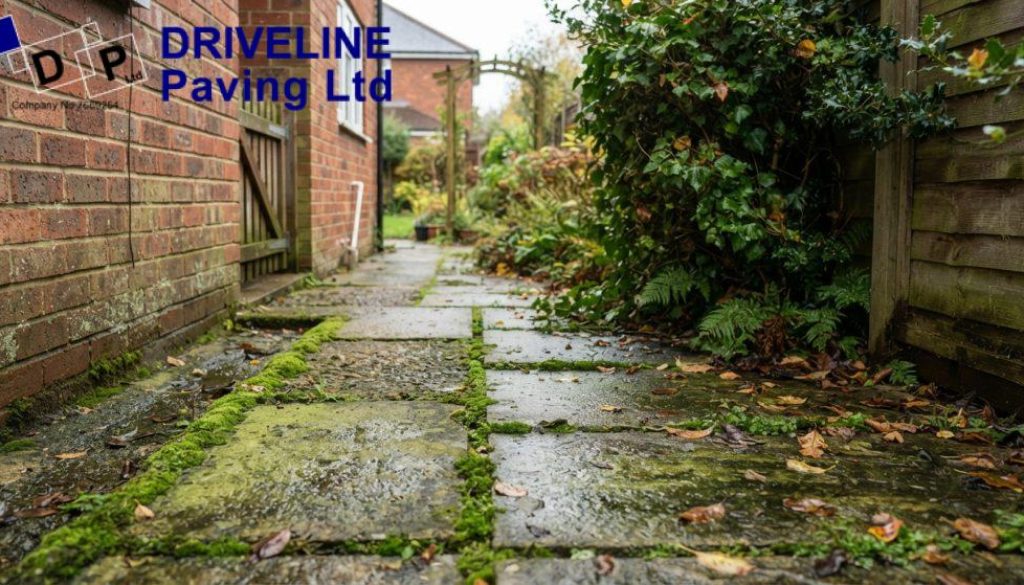
Paving that looked fine in August turns green in a matter of weeks once the weather changes. Moss on paving spreads faster in autumn than at any other point in the year, and the shaded side of a path can go from clear to slippery between one weekend and the next.
There is a straightforward reason for the timing, and it explains why scrubbing the surface each spring never seems to solve anything. Clearing green growth is worth doing properly now, because a mossy path in October becomes a genuinely hazardous one by January.
Why Paving Turns Green in Autumn
Moss and algae need three things, and September delivers all of them at once.
They need moisture, which arrives with longer periods of rain and no longer evaporates because the surfaces stay cold. They need low light, and the sun drops far enough in the sky that shaded areas beside fences, walls and hedges stop drying out at all. Then leaf fall adds a layer of organic matter that holds water against the paving and feeds what is growing in it.
North-facing paving suffers most. So does anything under a tree canopy, anything in the lee of a north or east wall, and any surface where water sits rather than draining away.
Weeds Do Not Grow Through Paving, They Grow On It
This is the part most homeowners have backwards, and getting it right changes how you deal with the problem.
Seeds do not push up through a paving slab or a concrete block. They blow in, land in the joints, and germinate in the silt and organic debris that has collected there over the years.
A joint packed with clean sand or grit gives a seed nothing to root into. One that has filled with soil, moss and leaf mould, though, is effectively a long, thin window box, and plants respond to it exactly as you’d expect
That is why weeds return to the same corner year after year no matter how many times they are killed off. The chemical deals with the plant. It does nothing about the growing medium that plant was sitting in, so the next batch of seed arrives to find the same conditions waiting.
The practical conclusion is that joint condition is the whole game. Clearing weeds without restoring the joints buys you one season.
Slip Resistance Matters More Than Appearance
Green paving is unsightly, but that is the least of it, particularly for anyone with limited mobility on the property.
Wet moss and algae form a film that reduces grip substantially, and it does so on exactly the surfaces people use in the dark: front paths, steps, the route from the car to the door. Steps are the highest risk, since the tread edge is where moss collects and where a slip has the furthest to fall. If you deal with only one area this autumn, make it any flight of steps and the approach to the front door.
Clearing Moss and Algae Without Damaging the Surface
Different materials tolerate different treatment, and the fastest method is not always the one the paving will survive.
Start mechanically. A stiff brush and a joint scraper remove a surprising amount, particularly while growth is still soft and damp. Working dry material off with a brush before wetting anything makes the rest of the job easier.
Pressure washing works well on hard-wearing surfaces and causes real damage on others. Where it is suitable, use a fan nozzle rather than a pencil jet, keep the lance moving, hold it at a shallow angle rather than pointing straight down into joints, and accept that you will need to rejoint afterwards.
A pressure washer removes jointing sand very efficiently, which is fine if you plan to replace it and a problem if you do not.
|
Surface |
Suitable Approach |
Take Care With |
|
Concrete block paving |
Brushing, pressure washing on a fan setting |
Loss of jointing sand, always re-sand after |
|
Permeable block paving |
Brushing, specialist vacuum, hard surface cleaner |
Pressure washing drives silt deeper into the joints |
|
Porcelain slabs |
Brushing, warm soapy water, pressure washing |
Blasting grout or jointing compound out of the joints |
|
Sandstone and limestone |
Brushing, dilute hard surface cleaner |
High pressure erodes softer stone and pits the surface |
|
Concrete slabs |
Brushing, pressure washing |
Older slabs can spall if the surface has weathered |
|
Tarmac |
Brushing, low pressure washing only |
High pressure lifts the surface fines and loosens stone |
|
Resin bound |
Brushing, low pressure rinse |
Pressure above the manufacturer’s limit damages the resin |
Chemical treatments made for hard surfaces deal with algae and moss without the physical effort, and they generally slow regrowth for months. Follow the label rather than the internet, particularly on the question of dwell time and dilution.
Dealing With Weeds in the Joints
Removal is straightforward. Stopping them coming back is where the thinking goes.
For established weeds, a joint scraper or an old knife pulls out the plant along with the material it is rooted in, which is the outcome you want. Heat based weeders work well on seedlings and avoid chemicals entirely, though they need repeating as new seed germinates.
If you do use a weedkiller, there are a few things worth knowing that rarely appear on garden centre shelf talkers:
- Products for hard surfaces are approved for targeted application to visible weeds, not for blanket spraying of a whole drive.
- Label guidance restricts treatment to periods when weeds are actively growing, which in practice means roughly March to October. Autumn is the closing end of that window, so anything applied much later achieves very little.
- Hard surfaces do not absorb what lands on them. Whatever does not stick runs off, which is why labels warn against overspraying drains and gullies. On a driveway that feeds a channel drain, that run-off goes somewhere.
- Only products authorised for hard surface use should be applied to paving at all.
For most domestic paving, mechanical removal followed by proper rejointing outperforms repeated spraying, because it removes the conditions rather than the symptom.
Refilling Joints and Stopping Regrowth
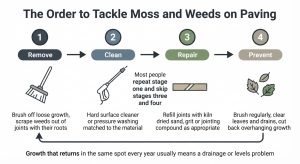
This is the step that turns a clean-up into a fix, and it is the one most often skipped.
Once the paving is clear and dry, joints need refilling with the right material for the surface:
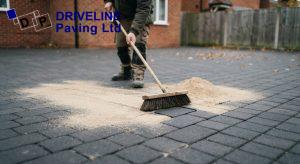
- Standard block paving takes kiln dried sand, brushed in dry and worked into the joints. Expect to top it up after the first heavy rain, since the sand settles.
- Permeable block paving takes clean angular grit, not sand. Sand defeats the purpose by sealing the joint that the whole construction depends on.
- Slabs and patios can be repointed with mortar or a proprietary jointing compound, which resists weed growth better than sand on wider joints.
Beyond jointing, prevention is mostly housekeeping. Brushing paving regularly through autumn removes the leaf litter before it breaks down into the soil that seeds need.
Clearing gutters and channel drains stops water sitting on the surface. Cutting back overhanging shrubs lets light and air reach shaded areas, which does more to discourage moss than any product.
When Green Growth Is Telling You Something Else
Sometimes moss is a cleaning job. Sometimes it is a symptom, and treating the surface repeatedly is dealing with the wrong problem.
Growth that returns quickly in one specific area, particularly where water pools, usually indicates a drainage or level fault rather than a hygiene one. Paving that holds water stays damp for days, and damp paving in shade will always go green whatever you spray on it. In those cases the lasting fix is correcting the falls or adding drainage, which is groundwork rather than gardening.
The same applies to moss growing thickly in joints that have opened up. Wide, empty joints indicate loose blocks or a failed edge restraint, and refilling them without addressing the movement is a temporary measure.
Keeping Paths and Patios Safe Through the Wet Months
Autumn is the sensible time for this work because the growth is soft, the weather still allows treatments to dry, and everything you do now holds through the months when paving is at its slipperiest and least pleasant to work on.
If your paving greens over every year in the same place, or the joints keep emptying however often you top them up, there is usually something underneath worth looking at.
Driveline Paving handles patio paving and garden landscaping across Essex and North London, including relaying paving where drainage or levels are the real cause. Our patio team covering Buckhurst Hill and nearby areas will tell you whether it is a maintenance issue or a groundwork one.
To arrange a look, get in touch for a free quote or call 01992 879701. Keep it local, Keep it Driveline.


