Is Autumn a Good Time to Lay a New Driveway in Brentwood?
There is a widespread assumption that driveway work is a summer job and that anything booked after August is pushing its luck. It is worth examining, because it costs people a season of use and pushes a lot of unnecessary demand into April and May.
Autumn driveway installation is entirely workable for most surfaces in most weeks of September and October. What matters is not the month on the calendar but two specific conditions: the temperature the material is laid at, and how much water is in the ground.
Those two factors affect block paving, tarmac and resin bound very differently, and knowing which applies to your chosen surface tells you far more than any general rule about seasons.
What Actually Limits Driveway Work
Every surfacing material has conditions it needs, and they are physical rather than seasonal.
Some materials cure through a chemical reaction that slows or stops when it gets cold. Others are laid hot and have to be spread and compacted before they lose their working temperature.
A few are unbound, meaning they are simply laid and locked mechanically, and those are largely indifferent to the weather. Underneath all of them sits the sub-grade, which has to be firm enough to compact a sub-base onto.
September and October in Essex usually sit comfortably within workable limits. The constraints tighten from November onwards, and they tighten unevenly across the different surfaces.
How Each Surface Handles Autumn Conditions
The differences here are substantial enough to influence which surface you choose if you want the work done this side of Christmas.
|
Surface |
Autumn Suitability |
Main Constraint |
|
Block paving |
Very good, laid in most conditions |
Excavation in saturated ground |
|
Permeable block paving |
Very good |
Excavation in saturated ground |
|
Gravel |
Very good |
Ground conditions only |
|
Tarmac |
Good in September and October |
Cools too fast below roughly 10°C, cannot be laid in rain |
|
Resin bound |
Good in dry spells |
Needs above roughly 5°C, a dry base and no overnight frost |
|
Concrete or a concrete base |
Reasonable, watch the forecast |
Will not cure properly below 5°C |
Block Paving Is the Autumn and Winter Option
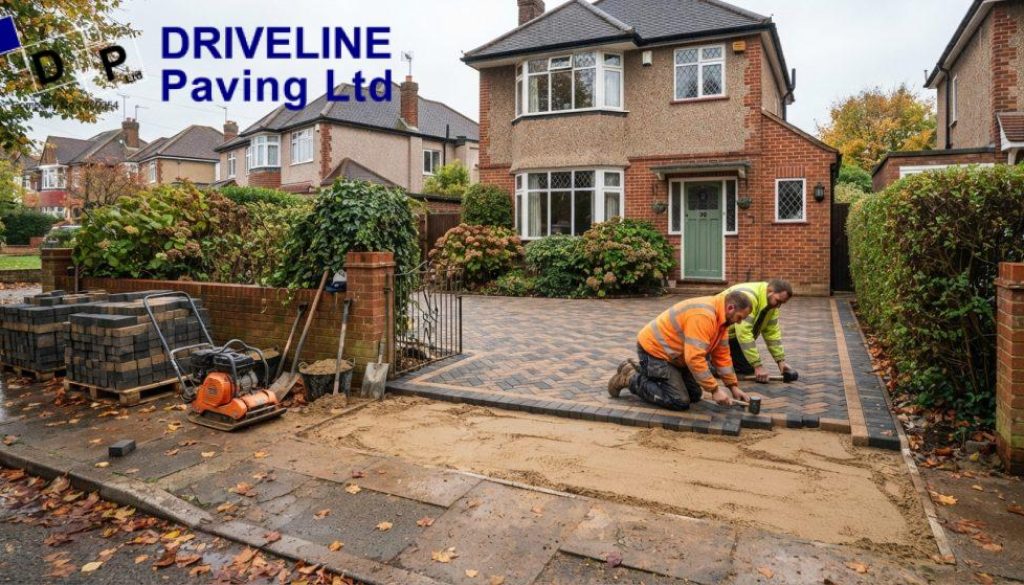
Block paving is laid on a compacted sub-base and a sand laying course, with the blocks locked together by jointing sand. Nothing cures, nothing needs to stay warm, and nothing is ruined by a shower partway through the day. Work can pause and resume without compromising the result.
That flexibility is why block paving fills so many autumn and winter diaries. If you want certainty about dates rather than a booking that moves with the forecast, it is the straightforward answer.
Tarmac Is Working Against a Clock
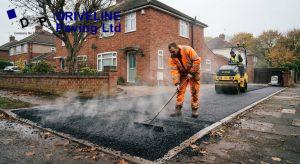
Tarmac arrives hot and has to be spread, levelled and compacted before it cools. In warm weather, there is a comfortable working window. As air and ground temperatures drop, that window shortens, and the material stiffens while the crew are still trying to work it.
Trying to lay tarmac in genuinely cold conditions is like spreading butter straight from the fridge. It can be done, but it tears rather than spreads, and the finish shows it. Poor compaction is not a cosmetic issue either, since it leaves voids that let water in and shorten the life of the surface.
September and much of October are usually fine for tarmac driveways in Essex. It is also the reason a good contractor will move a tarmac date rather than lay it on a cold, wet morning.
Resin Bound Needs a Dry Window
Resin bound surfacing cures through a reaction between resin and hardener, and both moisture and cold interfere with it. The general position across manufacturers is that it should not be laid in rain or below around 5°C, and the base it goes onto has to be dry as well as the air.
Overnight frost is the factor people forget. A mild afternoon is no help if the surface drops below freezing before the resin has cured. This means resin work in autumn gets booked around dry spells rather than fixed dates, which most homeowners find perfectly acceptable once it is explained upfront.
Ground Conditions on Brentwood’s Clay
Local geology is the part of this that is genuinely specific to where you live, and Brentwood sits on London Clay.
Clay holds water. Through a dry summer it is firm and easy to work. As autumn rain accumulates, the sub-grade softens, and by midwinter an excavated clay formation can turn to a churn under machine tracks. That is the real seasonal limit on driveway work in this part of Essex, and it has nothing to do with the surface material.
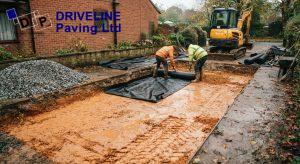
Early autumn sits in a useful window. The ground still carries the plant reasonably well, excavation is clean, and the sub-base can be compacted properly onto a firm formation. Leave it until December or January and the same dig becomes slower, messier and more likely to need a geotextile membrane and additional stone to bridge soft ground.
Clay moves seasonally as well, shrinking as it dries and swelling as it wets. That is one of the reasons a properly specified sub-base on clay ground is built deeper than the minimum, and it is worth asking any contractor what depth they are allowing for.
Why September Is the Practical Booking Window
The trade calendar matters as much as the weather, and it works in a way most homeowners never see.
Enquiries spike in spring and again in early autumn. Diaries fill from the point people start booking, so a September enquiry generally gets an autumn slot while an October enquiry increasingly gets a slot in the new year. The work is the same, the wait is not.
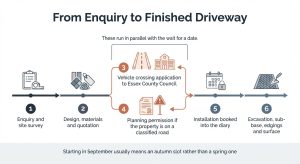
There is also lead time on approvals that has nothing to do with the contractor:
- Vehicle crossing applications. A new or widened dropped kerb goes to Essex County Council through Essex Highways, and approval is not immediate.
- Planning permission where it applies. In Essex, properties on a classified A, B or Class III road need planning permission before applying for the crossing, which adds another stage.
- Design decisions. Choosing materials, colours and layout takes longer than people expect once samples are involved.
Starting the conversation in September means those stages run in parallel with the wait for a slot rather than beginning after it.
What Autumn Installation Looks Like on Site
Expectations are easier to manage when you know what is different about working at this time of year.
Days are shorter, so crews start and finish earlier and a job that takes three days in June may run to four. Forecasts are watched more closely, and a date for tarmac or resin may shift by a day or two.
Excavated spoil is wetter and heavier, which occasionally affects disposal. Newly laid tarmac takes longer to cool enough for traffic in cooler weather, though this generally works in your favour rather than against it.
None of that changes the finished result. A driveway laid correctly in October is indistinguishable from the same driveway laid in June.
Is It Better to Wait Until Spring?
Sometimes, and it is worth being straight about when.
Waiting makes sense if you specifically want resin bound and you are unwilling to accept flexible dates, or if the existing surface is sound and this is a cosmetic upgrade with no urgency. It also makes sense if the ground is already waterlogged and the work is not pressing.
Waiting makes less sense if the existing drive is failing. A cracked or sinking surface takes water all winter, and freeze and thaw cycles widen every fault. You would be paying to store a problem, then joining the spring queue with a worse starting point.
Waiting also means another winter of whatever prompted the enquiry: standing water, loose blocks or a surface that has become slippery.
Planning a Driveway in Brentwood This Autumn
Autumn suits driveway work better than its reputation suggests. Block paving and gravel can be laid throughout, tarmac is comfortable through September and October, and resin bound is fine given a dry spell. The only constraint in this area is saturated clay in midwinter, which is an argument for booking now rather than waiting.
Driveline Paving has laid drives across Essex and North London for years, and our driveway installers will advise on which surface fits both your property and the time of year rather than selling you the one with the longest wait.
You can see finished work in a range of materials in our project gallery, or compare the driveway options we install.
For a survey and a date, get in touch for a free quote or call 01992 879701. Keep it local, Keep it Driveline.


