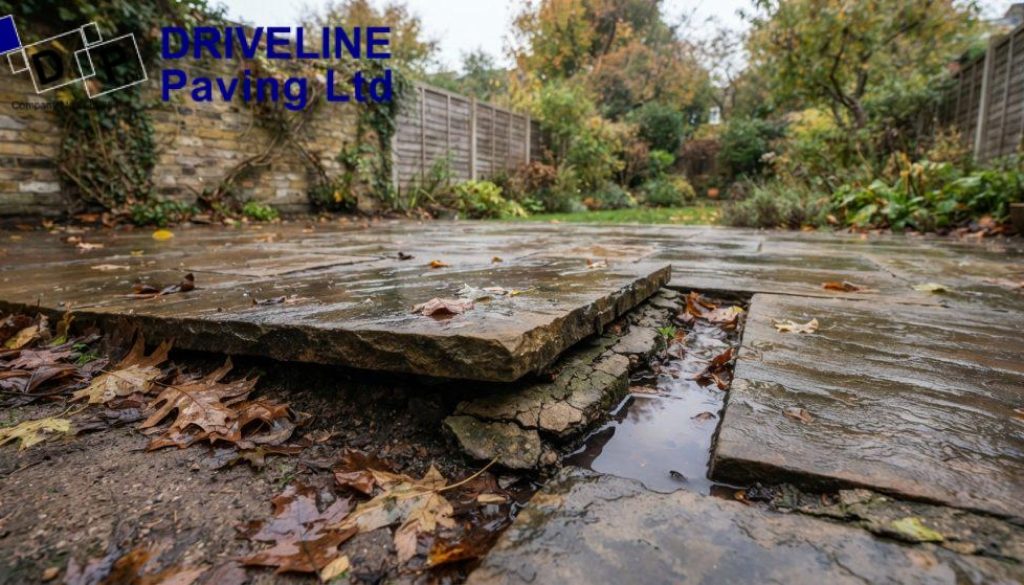
Loose Patio Slabs: Why They Rock and How to Fix Them Before Frost
A patio slab that rocks underfoot is easy to ignore in summer. You step around it, put a plant pot on it, and it becomes part of the garden. Loose patio slabs are worth taking seriously before winter, though, because autumn rain and the first frosts are exactly the conditions that turn one wobbly slab into several.
The good news is that a single loose slab is usually a straightforward repair. The important part is understanding why it came loose, because relaying it the same way it was first laid only buys a year or two.
This guide covers how to diagnose a loose slab, the most common causes, why October is the time to deal with it and what a proper repair involves.
How to Tell a Loose Slab From a Sinking Patio
Not every uneven slab has the same problem. Before deciding on a fix, it helps to work out which of two things is happening.
A loose slab has lost its grip on the mortar bed beneath it. It rocks when you step on a corner, clicks or knocks, and may sound hollow when tapped. The slab itself usually sits at roughly the right height.
A sinking slab has dropped below its neighbours. It may feel solid, but it sits in a dip and collects water. That points to a problem lower down, in the sub-base or the ground beneath.
A simple tap test helps. Gently knock across the slab with the handle of a screwdriver or a rubber mallet. A solid, dull sound means the slab is bedded. A hollow, drum-like sound means there is a void underneath, even if the slab does not yet move.
After rain, watch for one more sign. If muddy water squeezes up through the joints when you step on a slab, water has got underneath and is washing the bedding away.
Why Patio Slabs Work Loose
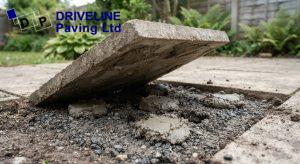
Loose slabs almost always trace back to how they were laid. Weather and age expose the weakness, but they rarely create it on their own.
Spot Bedding
Spot bedding, sometimes called dot and dab, means setting a slab on five small piles of mortar, one at each corner and one in the middle, instead of a continuous bed. It is quicker and uses less mortar, which is why it still turns up on patios.
The trouble is the gaps between the dabs. A slab on five dabs is like a plank laid across stepping stones. It holds firm while you stand over a stone, but step on the unsupported span and it flexes. Over time that flexing cracks the dabs or breaks the bond, and the slab starts to rock. The hollow spaces also collect water.
UK paving guidance calls for slabs to be laid on a full bedding layer, and this is the standard a good installer works to.
Porcelain Laid Without a Primer
Porcelain is dense and absorbs almost no water, which is part of why it is so easy to keep clean. That same quality means ordinary mortar has very little to grip on its smooth underside.
To fix this, installers brush a slurry primer onto the back of each porcelain slab just before laying. It works as a bonding bridge between the slab and the mortar. Without it, a porcelain slab can sit on a perfectly good bed held only by its own weight, and it may lift away cleanly after a winter or two.
Weak or Crumbling Mortar
A mortar bed that is too lean, mixed with the wrong sand or laid in cold weather can lack the strength to hold a slab. It may look fine at first and then turn powdery as water and frost work into it.
A Poor Base Underneath
A full mortar bed still needs firm ground beneath it. Slabs laid on soft soil, or on a sub-base that was never properly compacted, can settle unevenly. Once one edge drops, the slab loses contact with part of its bed and begins to move.
Water With Nowhere to Go
Patios are laid with a slight slope, known as a fall, so rain runs off rather than sitting on the surface. If the fall runs the wrong way or was never built in, water pools and seeps through the joints into the bedding. Repeated soaking weakens the mortar and washes away fine material.
Why Autumn and Winter Make Loose Slabs Worse
A loose slab in July may stay much the same until September. Over the colder months, several things start working against it at once.
Autumn rain fills any hollow space under a slab. When temperatures drop below freezing, that trapped water turns to ice and expands. The ice pushes on the slab and the surrounding mortar, and when it thaws the gap is a little bigger. Repeat that across a cold spell and a slight rock becomes a slab that lifts at one corner, with cracked pointing either side.
Fallen leaves add to the problem by holding moisture on the surface for days. Water then gets into cracked joints and down to the bed.
There is a safety side too. A lifted edge is easy to miss on a wet patio in the dark, and the clocks going back means more trips to the bins and the shed after sunset.
Symptoms and Likely Causes
Matching what you can see with what is probably happening underneath will help you decide whether the job is small or part of a wider problem.
|
What you notice |
Likely cause |
Usual fix |
|
One slab rocks or clicks, others feel solid |
Spot bedding or a failed bond under that slab |
Lift, clear the old bed and relay on a full mortar bed |
|
Porcelain slabs lift away cleanly with no mortar attached |
No slurry primer used when laid |
Relay each slab with primer on a fresh bed |
|
Hollow sound when tapped, but no movement yet |
Voids under the slab |
Monitor, then relay before it starts to move |
|
Muddy water squeezes up through joints after rain |
Water under the slab washing out the bedding |
Relay and check the fall and drainage |
|
Several slabs loose across the patio |
Poor laying method or weak mortar throughout |
Assess for a larger relay |
|
Slab has sunk into a dip |
Soft ground or poor sub-base |
Lift, correct the base, then relay |
What You Can Do Before It Is Repaired
Some quick steps will stop a loose slab getting worse or causing a fall until it can be relaid properly.
Mark the slab or put a heavy planter beside it so people know to avoid it, particularly after dark. Keep leaves and standing water off the area, and clear any weeds growing out of the joints, as roots open them further.
There are also things best avoided. Pouring sand or squeezing adhesive into the gaps does not reach the void underneath and makes a proper repair harder later. Repointing around a rocking slab will only crack again, because the movement is coming from below the joint, not from the joint itself.
How a Loose Slab Is Relaid Properly
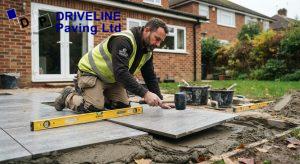
A good repair deals with the cause rather than just fixing the slab back down. For a single slab or a small group, a contractor will usually work through these stages.
- Cut out the pointing around the slab so it can be lifted without chipping its neighbours.
- Lift the slab and check its underside. This shows whether it was spot bedded, unprimed or sitting on crumbling mortar.
- Break out the old bedding completely. Laying fresh mortar over a failed bed repeats the problem.
- Check the base. If the ground below is soft or uneven, it is firmed up or topped up with compacted sub-base material.
- Prime the slab where needed. Porcelain always gets a slurry primer, and many installers prime natural stone too.
- Lay a full mortar bed and set the slab into it, tapping it down with a rubber mallet until it sits level with its neighbours and follows the patio’s fall.
- Repoint the joints once the bed has firmed up, and keep heavy weight off the slab while the mortar cures.
Timing matters at this stage. Mortar can be damaged if it freezes before it has cured, so repairs are best done before overnight frosts become regular.
Repair or Relay the Whole Patio
One or two loose slabs on an otherwise solid patio are a repair job. Once the problem spreads, it is worth stepping back.
When slabs are coming loose across the whole area, the cause is usually the original laying method rather than bad luck with individual slabs. Fixing them one by one each winter costs more over time than lifting the lot and relaying on a proper base. A full relay is also a chance to correct falls, add drainage and reuse sound slabs where possible. If you are weighing that up, our page on patio installation explains how we prepare and lay patios to last.
Loose block paving on a driveway is a different problem. Blocks sit on sand rather than mortar, and they move for different reasons, which we cover in our guide to sunken block paving.
Fixing Loose Slabs Before the First Frost
Loose patio slabs are one of the easier outdoor repairs to put right, as long as they are dealt with before water and ice get to work underneath. October usually gives enough mild, dry days for mortar to cure properly, which becomes harder once winter arrives.
If you have slabs that rock, sound hollow or have started to lift, Driveline Paving can inspect the patio, find the cause and relay the affected slabs on a full, properly primed bed. We work across Essex and North London, and our patio installers in Enfield and nearby areas handle everything from single-slab repairs to full patio relays. Arrange a patio repair quote or call 01992 879701 for free, no-obligation advice. Keep it local, Keep it Driveline.


