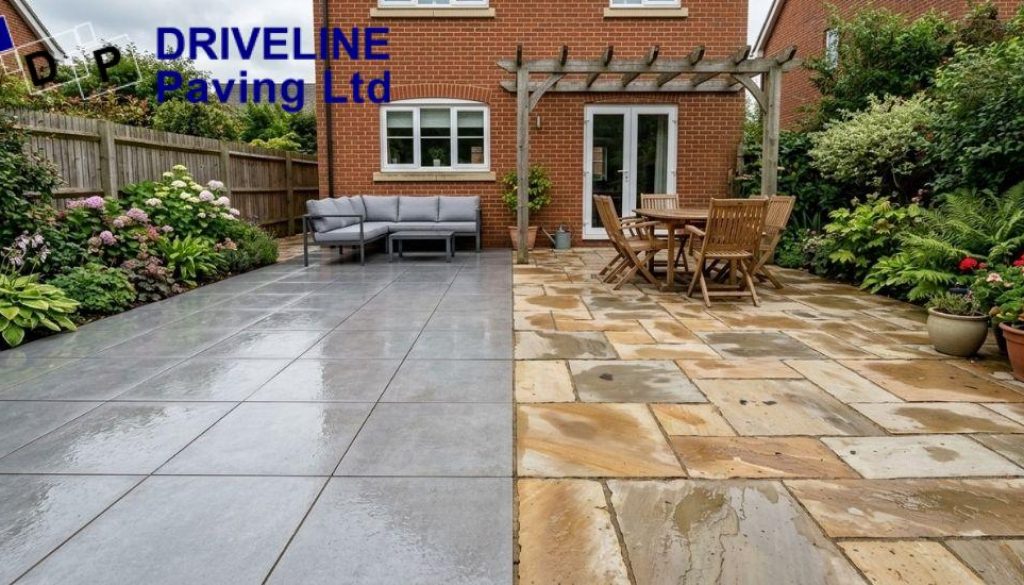
Porcelain vs Sandstone Patios: A Homeowner’s Guide
A patio is a twenty-year decision sitting in full view of your kitchen window, so the choice of material deserves more than a quick scroll through photos.
Porcelain and sandstone are the two surfaces most homeowners weigh up, and both look excellent once laid. Where they part company is upkeep, grip, cost and the way they age through a British winter.
Here is how the two compare, based on what actually happens to these surfaces in gardens across Essex and London.
What Is Porcelain Paving?
Porcelain is a manufactured slab, and the manufacturing is the whole story.
Refined clay, sand and mineral oxides are pressed under high pressure and fired at roughly 1,200°C. The result is a slab almost completely closed to water, with absorption rates typically below 0.5 per cent.
Think of a dinner plate: spill gravy on one and it wipes away, because there is nowhere for the liquid to go. Outdoor porcelain applies the same physics at 20mm thick.
What that gives you:
- Consistent colour and sizing from pack to pack
- Calibrated thickness, so slabs sit level with less packing
- Finishes copying stone, timber, concrete and marble
- Very low staining risk from wine, oil, barbecue fat or leaf tannins
What Is Sandstone Paving?
Sandstone comes out of the ground rather than a factory, which explains both its charm and its quirks.
Most sandstone sold here is quarried in India and split along natural bedding planes, giving a riven, slightly uneven face. No two slabs match exactly. Colour shifts across a pack, from buff and grey through to warm autumn tones with rust-coloured veining.
Because it is sedimentary rock, sandstone is porous. Absorption sits somewhere between 1 and 6 per cent depending on grade, so it drinks in rainwater, spilled drinks and anything else that lands on it.
Porcelain vs Sandstone at a Glance
Before the detail, here is the short version.
|
Porcelain |
Sandstone |
|
|
Water absorption |
Below 0.5% |
1% to 6% |
|
Sealing |
Never |
Every 2 to 4 years |
|
Slab cost |
Higher |
Lower |
|
Laying cost |
Higher |
Standard |
|
Colour |
Uniform, stays put |
Varied, mellows |
|
Frost risk |
Very low |
Low to moderate |
|
Best suited to |
Modern gardens |
Period gardens |
The rest of this guide explains what those differences feel like once the patio is down and you are using it every day.
Looks and Finish
Appearance usually settles the decision, and the two materials pull in opposite directions.
Porcelain suits contemporary gardens. Large-format slabs, tight 3mm to 5mm joints and a flat, even surface create clean lines that sit well alongside rendered walls, composite decking and glass balustrades. Grey remains the strongest seller, though beige and sand tones have gained ground.
Sandstone suits period properties and planted, informal gardens. The riven texture catches light differently through the day, and the colour variation softens as planting grows over the edges. Next to a Victorian brick terrace, sandstone rarely looks wrong.
One practical point: porcelain looks the same in year ten as it did on day one. Sandstone weathers, mellows and picks up character. Whether that counts as a benefit depends entirely on your taste. Buyers looking for a crisp, showroom finish tend to prefer porcelain. Anyone who likes a garden that looks settled after a couple of seasons usually goes for stone.
Maintenance and Cleaning
This is the biggest day-to-day difference between the two surfaces.
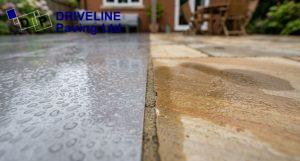
Porcelain upkeep:
- Sweep and wash with warm soapy water
- No sealing required, ever
- Algae struggles to take hold, as there is no pore structure to grip
- Stains sit on the surface and lift off
Sandstone upkeep:
- Seal after installation, then reseal every two to four years
- Expect green growth on shaded or north-facing areas
- Wash annually with a stone-safe cleaner
- Oil, wine and rust marks can soak in and become permanent if left
Neither surface is difficult to live with. Sandstone asks for a weekend of attention now and then. Porcelain asks for almost nothing.
Cost: Slab Price Versus Total Spend
Comparing the two on slab price alone gives a misleading picture.
Sandstone usually costs less per square metre to buy. Porcelain sits higher, although the gap has narrowed as supply has grown.
Installation flips the maths. Porcelain must be laid on a full mortar bed with a slurry primer coat on the back of every slab, and cutting it calls for diamond blades and patience. Labour costs more.
Then there is the long view:
- Sandstone: lower upfront cost, plus sealing materials and time every few years
- Porcelain: higher upfront cost, minimal spend afterwards
- Both: the sub-base costs the same either way, and skipping it ruins both
Across fifteen years the two often land in a similar place. Across five, sandstone is cheaper. It is worth pricing the patio as a finished job rather than a pile of slabs, since edging, drainage, waste removal and steps all sit in the same quote.
Grip, Frost and British Weather
Safety matters more than most people expect, particularly on a patio by a back door.
Quality outdoor porcelain carries an R11 slip rating as standard, which holds up well in the wet. Near-zero absorption also means water cannot get inside the slab, freeze and expand, so frost damage is not a worry.
Sandstone with a riven face offers natural texture and decent grip. Porosity is the weak point. Water sitting in the stone through a hard frost can cause surface flaking on lower grades, and damp shaded areas turn slippery with algae if cleaning gets skipped.
Both need falls of roughly 1:80 away from the house so rainwater runs off instead of pooling. Where a patio replaces lawn or borders, the water has to go somewhere sensible, whether that is a permeable joint, a channel drain or a planted bed. Skipping that step causes standing water, which does the slabs no favours in either material.
Which Patio Suits Your Garden?
A quick way to narrow it down.
Choose porcelain if:
- You want low maintenance and a modern look
- The patio sits in shade where algae would otherwise thrive
- Children, dinner parties or a barbecue make spills likely
- You plan to stay in the house long term
Choose sandstone if:
- Your home is period or traditional in style
- You like natural variation and a surface that mellows
- Budget is tighter at the outset
- You are happy to seal and clean it every couple of years
Installation Matters More Than the Slab
The best slab in the world fails on a poor base.
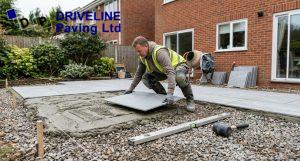
Both materials need excavation to the right depth, a compacted MOT Type 1 sub-base, correct falls and full mortar support beneath every slab. Hollow spots crack porcelain and rock sandstone loose. Porcelain adds the extra step of priming each slab so the mortar bonds properly.
Driveline Paving installs both across Essex and London, and often pairs a new patio with wider landscaping or a matching driveway so the garden and frontage work together. Every job is guaranteed and quotes are free. Get in touch for honest advice on which surface suits your garden.


