Driveway Repair or Replacement: How to Decide
Most homeowners judge a driveway by how it looks, which is understandable and almost entirely the wrong test. A drive can look dreadful and be structurally perfect. It can also look acceptable while the ground beneath it has already given up.
Choosing between driveway repair or replacement is a decision about what is happening below the surface. Get that judgement right and a repair buys years of service for a fraction of the outlay.
Get it wrong and you pay twice, because a new surface laid over a failing base fails in exactly the same way the old one did, usually within a few years.
When the Surface Is Not the Problem
Every hard surface sits on a compacted sub-base, and that layer carries the weight of the vehicles. The tarmac, blocks or resin on top are a wearing course. They take the abrasion, shed the water and provide the finish, but they are not what holds a car up.
That distinction settles most repair and replacement questions. If the sub-base is intact and only the wearing course has deteriorated, you are looking at a repair or a resurface. If the sub-base has moved, washed out or was never adequate, no amount of work on the surface will hold.
Signs Only the Surface Has Failed
These faults sit in the top layer, and they are usually straightforward to put right without disturbing anything structural.
- Tarmac that has faded to pale grey and lost its fines, leaving loose stone on the surface
- Shallow surface cracking that has not opened up or connected into a network
- A single pothole or a small area of damage in an otherwise sound drive
- Moss, algae and general staining
- Empty joints on block paving where the kiln dried sand has washed out
- One or two blocks that have dropped or come loose
- Weed growth through joints on an otherwise stable surface
- Crumbling along an exposed edge where there is no restraint
None of these indicate a problem below. They are the normal consequences of weather and use.
Signs the Structure Has Failed
These are different in kind, not just degree, and they point at the layers underneath.
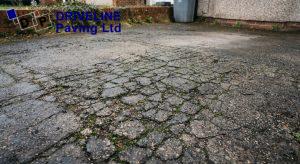
- Interconnected cracking in a pattern of small linked sections, sometimes called fatigue or crocodile cracking, which indicates the base is flexing under load
- Water that pools and stays after every shower, meaning the falls have deformed
- Settlement across a wide area rather than in one spot
- Large sections that move underfoot or feel spongy when driven over
- Potholes that go all the way through to the stone beneath
- Blocks that have spread outwards with wide open joints along the perimeter
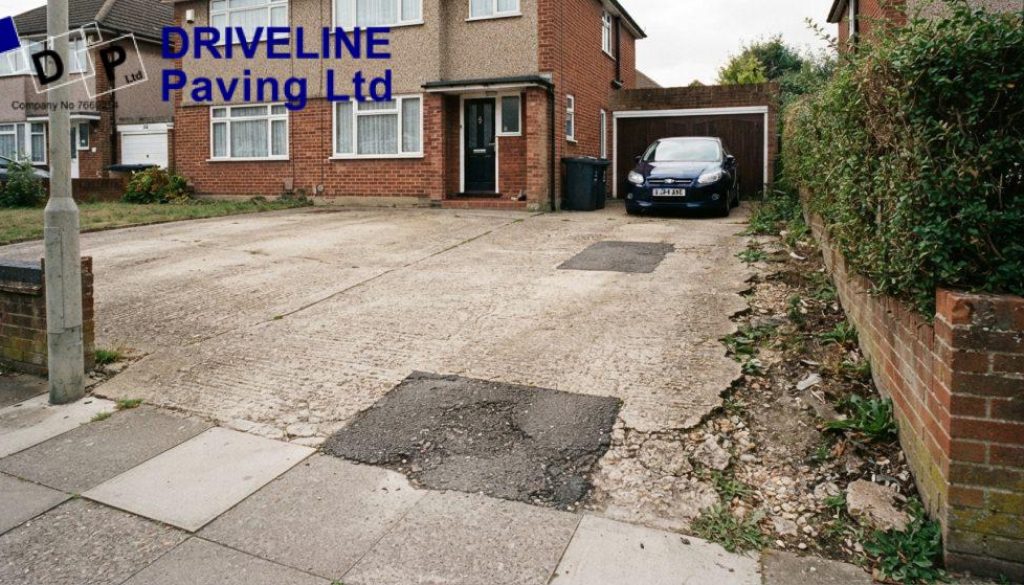
- A drive that has already been patched several times in different places
The last one deserves attention. A patchwork surface is not just untidy. Repeated repairs in different locations tell you the base is failing generally rather than at one point, and each patch treats a symptom while the underlying cause carries on.
Comparing the Three Realistic Options
There are more choices than repair or replace, and the middle route is often the one that suits. The table below sets out what each actually addresses.
|
Localised Repair |
Resurface or Relay |
Full Replacement |
|
|
What it does |
Fixes one damaged area |
Renews the surface, keeps the base |
Rebuilds from the sub-base up |
|
Right when |
Damage is isolated and the base is sound |
The base is sound but the surface has gone |
The base has failed or was never adequate |
|
Disruption |
Usually a day |
Two to three days on a typical drive |
Several days, including excavation and disposal |
|
What it will not fix |
Anything structural |
Drainage faults, incorrect falls, base movement |
Nothing, provided it is specified properly |
|
Planning implications |
None under 5 square metres |
Depends on the surface used |
Permeable specification keeps it within permitted development |
What Each Option Involves in the Process
The difference between these routes is mostly a question of how far down the work goes.
Localised Repair
On block paving, the affected blocks are lifted, the laying course and any disturbed sub-base are rebuilt to the correct level and compaction, and the original blocks go back down. On tarmac, the damaged area is cut out cleanly, the base is checked and made good, and new material is laid and compacted to match.
The main limitation is cosmetic. Surfaces weather, so a repair rarely matches the surrounding area exactly. On tarmac the patch stays visibly darker for a long time. On block paving, spare units kept from the original installation are worth their storage space.
Resurfacing or Relaying
Tarmac can take an overlay, meaning a fresh wearing course bonded over the existing surface, provided the base is genuinely sound. Block paving is not resurfaced in the same sense. It is lifted, the layers below are corrected, and the same blocks are reset, which is one of the real advantages of the material.
Overlays come with a caution that is easy to overlook. Cracks in the layer beneath tend to find their way up through a new surface, the way a crease in wrapping paper reappears however carefully you smooth the sheet over it. This is called reflective cracking, and it is why an overlay on a base that is moving is money spent for a short reprieve rather than a fix.
Full Replacement
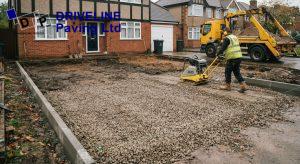
Excavation, disposal, a properly compacted sub-base in layers, correct falls, edge restraints and drainage all get addressed together. It costs more and takes longer, and it is the only route that resets the condition of the whole construction. It is also the point at which the specification can be changed rather than repeated.
Three Practical Factors That Tip the Decision
Beyond the condition survey, three constraints often settle the matter, and none of them are obvious from looking at the surface.
Levels and clearance. Every overlay raises the finished height, typically by a few centimetres. Paving needs to sit at least 150mm below the damp proof course, and it has to clear thresholds, garage doors and gates. A drive that has already been overlaid once may have no height left, which makes excavation the only option.
Drainage. An overlay follows the shape of what is underneath it. If the drive already holds water, resurfacing preserves the problem and sometimes worsens it by reducing the fall at the edges. Where standing water is part of the complaint, the falls need rebuilding, and that means going down rather than up.
Planning. Repairs to under five square metres of existing hard surfacing sit outside the front garden paving rules. A full replacement over that size does not, so the new surface needs to be permeable or drain to a lawn or border. This is less of an obstacle than it sounds and more of an opportunity, since a permeable rebuild deals with the drainage fault that often caused the failure in the first place.
Age, Value and Knowing When to Stop Repairing
There is a point where continued repair stops being economical, and it is worth being honest about where that point sits.
A drive that has been patched three or four times, holds water in more than one place and moves underfoot has told you what it needs. Each further repair costs money that does not accumulate into anything.
Set against that, a properly rebuilt drive with correct falls and a permeable construction should require little beyond routine maintenance for a long time, and it removes the recurring annoyance of arranging visits every couple of years.
Kerb appeal is a genuine factor too, particularly for anyone planning to sell. A tired frontage is one of the first things a buyer registers, and unlike many improvements it is visible before anyone gets through the door.
Examples of finished work across different property styles are in our gallery of recent projects.
Getting a Straight Answer About Your Drive
The honest position is that nobody can tell you which route you need from a photograph. It takes someone on site, looking at where water goes, checking movement underfoot and, where there is doubt, opening up a small area to see what the sub-base is actually made of.
Driveline Paving carries out repairs, relays and full driveway installation across Essex and North London, including block paving, resin bound and tarmac driveways. We will tell you if a repair will do, because recommending a full replacement that is not needed is a poor way to run a local business.
If you would like an assessment from our driveway team covering Epping and the surrounding areas, get in touch for a free quote or call 01992 879701. Keep it local, Keep it Driveline.


