Driveway Drainage Problems in Chelmsford: Causes and Fixes
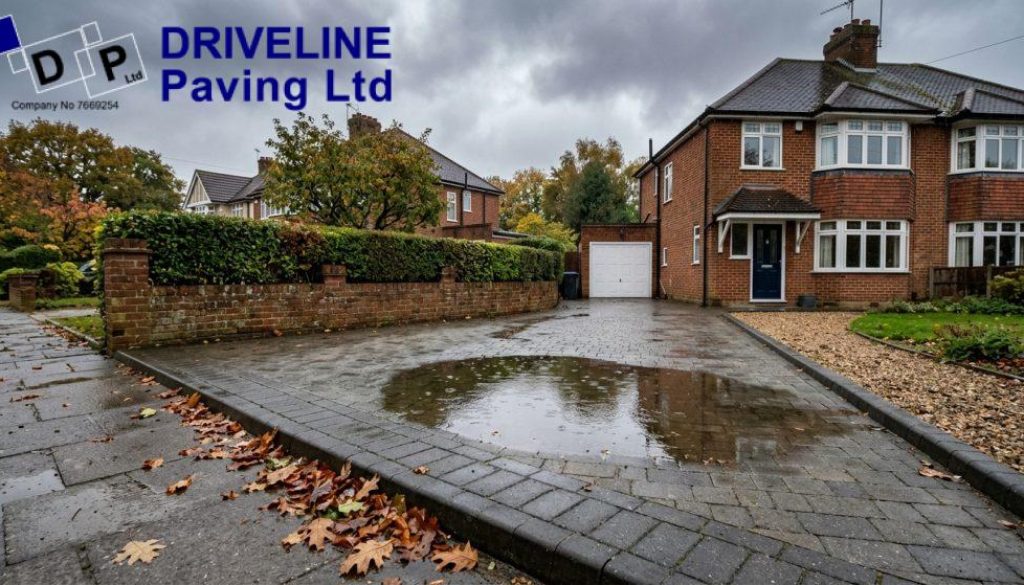
The first proper downpour of autumn tells you more about your driveway than the whole of summer did. Rain arrives, and either it disappears within a few minutes or it sits in a shallow pool by the garage door and stays there until Thursday.
Driveway drainage problems are close to invisible in dry weather and impossible to ignore in wet weather, which is why September is when homeowners across Chelmsford start looking properly at their drives.
Standing water is a symptom rather than the fault itself. Something has stopped working, and it is usually one of three things: the fall across the surface, the route water takes once it leaves that surface, or the ground’s ability to absorb it. Working out which one applies matters, because the fixes range from an afternoon of cleaning to lifting and relaying the whole drive.
Why Puddles Show Up After a Dry Summer
Nothing has necessarily changed about your driveway. What has changed is the volume and speed of the water landing on it.
Summer rain in Essex tends to be short and light, and a warm surface evaporates a thin film of water long before anyone notices it sitting there. A driveway with a poor fall can go from May to August without being properly tested. Autumn rain falls for longer, the surface stays cold, and evaporation stops helping. Water that was always struggling to run away now has nowhere to go and simply collects.
Dry summers add a second problem in this part of Essex. Clay shrinks as it dries out and swells again as it takes on water, and that seasonal movement can pull a sub-base very slightly out of shape. A dip of eight or ten millimetres is invisible to the eye but perfectly capable of holding a puddle the size of a doormat.
What Should Happen to Rain That Lands on Your Drive
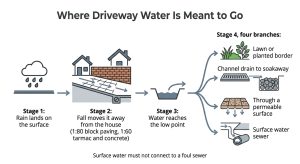
A well built driveway moves water in a deliberate direction, and every part of that route has to work for the surface to stay dry.
The starting point is the fall, which is the gentle slope built into the surface. Industry guidance puts the minimum at roughly 1:80 for block paving, which works out at about 12.5mm of drop for every metre of length.
Smoother surfaces such as tarmac and concrete shed water less readily and are usually laid to a steeper 1:60. The fall should always run away from the house, and the finished surface needs to sit at least 150mm below the damp proof course so that water cannot track back into the walls.
Once water reaches the low point, it needs somewhere legitimate to go. Building Regulations set out an order of preference for surface water: into the ground first, to a watercourse where that is not practical, and to a sewer only when neither of those works.
Surface water must not be connected to a foul sewer without consent, which is rarely granted. Draining a private drive out across the pavement is not an acceptable answer either.
That leaves most Chelmsford homes with one of four destinations:
- a lawn, planted border or gravel margin that can absorb the run-off
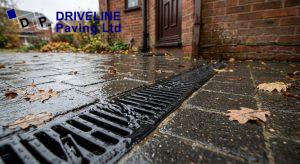
- a linear channel drain across the threshold, piped to a soakaway
- a permeable surface that lets water pass through the drive itself
- a surface water sewer, where the property has a connection to one
The Ground Under Chelmsford Makes Drainage Harder
Local geology has a direct effect on which of those options will actually work, and Chelmsford is a more demanding site than most.
The bedrock beneath the city is dominated by the London Clay Formation, with river terrace and glacial deposits closer to the watercourses. Chelmsford sits at the junction of four river valleys, is recognised by the Environment Agency as a Flood Risk Area, and ranks sixth in Essex for the number of properties at risk of surface water flooding. None of that is a reason to panic about a puddle, but it does explain why so many drives here struggle.
Clay is very slow to absorb water. A soakaway relies on the surrounding ground accepting water at a reasonable rate, and that rate has to be measured with a percolation test rather than assumed. Heavy clay frequently fails the test outright, which is why a soakaway that works well on a gravelly plot near the river can be the wrong answer half a mile away on the ridge.
Common Causes of Driveway Drainage Problems
Most drainage faults announce themselves in a specific way, and the pattern of the water usually points at the cause. The table below covers what we see most often on Chelmsford drives.
|
What You See |
Likely Cause |
Usual Fix |
|
Puddle in the same spot after every shower |
Localised dip in the sub-base |
Lift, re-level and relay that area |
|
Water running to the house rather than away |
Fall laid in the wrong direction |
Relay to correct falls, add a channel drain |
|
Whole surface slow to clear |
Insufficient fall overall |
Relay, or introduce positive drainage |
|
Permeable drive that no longer drains through |
Silt and moss blocking the joints |
Vacuum the joints and re-grit |
|
Channel drain overflowing |
Silt, leaves or a blocked outlet |
Clear the channel, jet the outlet pipe |
|
Water sitting after heavy rain only |
Soakaway saturated or undersized |
Percolation test, then resize or relocate |
|
Puddling that appeared after garden work |
Surrounding levels raised above the drive |
Reinstate falls at the edges |
Two of these deserve a closer look, because they are the ones homeowners most often misread.
Blocked Joints on a Permeable Drive
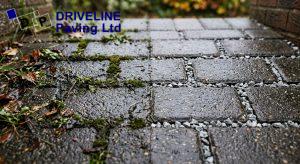
Permeable block paving works like a coffee filter. The water does not pass through the blocks themselves, it passes through the coarse grit in the joints between them. That filter only works while the grit stays open. Once a few years of silt, moss and general grime have packed the joints solid, the drive behaves exactly like an impermeable one and water sits on top of it.
This catches people out because nothing looks broken. The surface is intact, the blocks are sound, and yet the drive has quietly stopped doing the one thing it was chosen for.
The fix is straightforward; a specialist vacuum lifts the contaminated material out of the joints and fresh grit goes back in.
Raised Surrounding Levels
A driveway can be perfectly laid and still fail because of what happens next to it. New turf, a raised border, a gravel bed or a fresh layer of bark can all end up sitting higher than the paving edge. The water reaches the edge of the drive, finds a small kerb of soil in the way, and turns back.
What You Can Check Before Calling Anyone
A few minutes of observation during rain will tell you more than any amount of looking at a dry drive.
- Go out while it is actually raining and watch where the water travels. Note the direction it runs and the point where it stops.
- Measure roughly how far the finished surface sits below the door threshold and the damp proof course.
- Lift the grating on any channel drain and look inside. Silt and leaf litter are common and easy to clear.
- Check whether the ground beside the drive is higher than the paving.
- Look at the joints. On a permeable drive they should be filled with clean, loose grit rather than compacted dark material.
If the water has an obvious route and something is simply blocking it, that is often a maintenance job. If the water has nowhere to go at all, the problem is structural and needs a proper assessment.
How Drainage Faults Are Put Right
The right repair depends entirely on which part of the system has failed, which is why a survey comes before a quote.
Cleaning and re-gritting suits permeable surfaces that have silted up, and it restores the original performance without disturbing the blocks. Adding a linear channel drain works where the fall is broadly acceptable but water collects at a threshold or against a garage.
Relaying is the answer where the falls are wrong or the sub-base has deformed, and it is also the point at which many homeowners look at block paving driveways in a permeable specification rather than repeating the surface that failed.
Where the ground will accept water, a soakaway sized on percolation test results gives the run-off somewhere to go. Approved Document H requires soakaways to sit at least five metres from any building.
On clay plots where percolation is poor, a planted rain garden or a generous permeable border is often the more realistic route, and it has the advantage of keeping the whole scheme within permitted development.
Whichever approach fits, the work is easier and cleaner in early autumn than in December, when the ground is saturated and excavations fill as fast as they are dug.
Getting Your Drive Ready Before the Wet Months
A puddle in September is a minor annoyance. The same puddle in January is a frozen patch by the front door, a source of damp against the wall, and the beginning of blocks working loose as water washes material out from underneath them. Dealing with it now is considerably cheaper than dealing with the consequences in spring.
Driveline Paving has been laying and repairing drives across Essex for years, and our driveway specialists in Chelmsford will look at where the water is going before recommending anything. If you would like an assessment of a drive that holds water, get in touch for a free quote or call 01992 879701.
You can also see what our paving contractors in Chelmsford cover across the wider area. Keep it local, Keep it Driveline.