Sunken Block Paving: What Is Happening Under the Blocks
A dip appears near the garage door. A few blocks tilt underfoot when you walk over them. Water starts collecting in a spot that used to be flat. Sunken block paving is one of the most common faults we are called out to, and homeowners almost always describe it as a problem with the blocks.
It very rarely is. Concrete and clay pavers are enormously durable and will outlast most of what sits around them. When a block paved surface drops, something beneath it has moved, washed away or given up. The blocks are simply following whatever is happening underneath them, and reading that movement correctly is what separates a straightforward repair from an expensive one.
A Block Paved Drive Is Held Up by Three Layers
Understanding what fails means knowing what a properly built drive is made of, because each layer has a job and each one can fail differently.
Working from the bottom up, a domestic driveway is built as follows:
- Sub-base. Typically 100mm to 150mm of compacted crushed stone, laid and compacted in layers rather than all at once. Deeper build-ups are used on clay ground and where heavier vehicles will park. This layer carries the load.
- Laying course. Around 30mm of sharp sand once compacted, screeded to an exact level. This beds the blocks and nothing more. It is not a structural layer.
- Blocks and joints. Pavers of 60mm thickness are standard on domestic drives, laid tight and locked together by kiln dried sand brushed into the joints.
- Edge restraint. A perimeter course bedded and haunched in concrete, holding the whole field of blocks in place.
Think of the blocks as books on a tightly packed shelf. While they are wedged against each other and held at both ends, not one of them can tip over. Take a few out of the middle, or let a bookend slide away, and the rest begin to lean. A block paved drive works on the same principle, which is why the edges and the joints matter far more than most people expect.
What Makes the Surface Drop
Sunken block paving has a handful of causes, and they leave different signatures on the surface.
Water Washing Out the Fines
This is the most frequent cause we see, and it links directly to drainage. Where water is allowed to sit, or where it runs repeatedly over the same line, it gradually carries the fine material out of the laying course and the top of the sub-base. The blocks then have less to sit on and settle into the void.
The pattern is telling. Washout dips usually appear along a defined path, following the route the water takes rather than the route the cars take.
Sub-base That Was Never Adequate
A drive built on 50mm of stone tipped in and levelled by eye will look identical to a properly built one for the first couple of years. It fails once the ground beneath goes through a full cycle of wet and dry weather.
Compaction matters as much as depth. Stone compacted in a single deep layer never reaches the density it should, and it continues consolidating under traffic for years afterwards.
Edge Restraint Failure
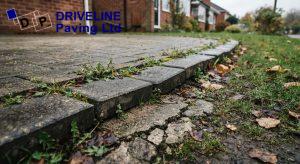
If the perimeter was laid without proper concrete haunching, or the haunching has cracked away, the blocks slowly migrate outwards. The joints open, the interlock is lost, and the surface starts to dish in the middle as individual blocks work loose.
You can usually spot this from the edges inward. Wide, sandy joints at the perimeter and blocks that have visibly crept beyond the original line are the giveaway.
Reinstated Service Trenches
Water, gas, electricity and telecoms runs all cross front gardens. When a trench is dug and backfilled without being compacted in layers, the ground above it settles over the following months. The result is a narrow linear dip running across the drive, often heading straight for the pavement.
Clay Movement and Tree Roots
Much of Essex sits on clay, which shrinks in dry summers and swells again in wet winters. That seasonal movement can be enough to deform a shallow sub-base. Mature trees make it more pronounced, since roots draw significant moisture out of the ground within their spread, and roots themselves can lift a surface from below.
Loads the Drive Was Never Built For
A drive specified for two family cars is not specified for a loaded skip lorry, a concrete mixer or a builder’s grab truck. One heavy delivery during an extension project is a common trigger for a dip that appears months later.
How to Read the Damage
The shape and position of the movement usually points at the cause before anyone lifts a single block.
|
What You See |
Usually Means |
|
Narrow dip in a straight line across the drive |
Poorly reinstated service trench |
|
Dish in the middle, wide joints at the edges |
Edge restraint failure |
|
Dip where water collects or runs |
Fines washed out of the laying course |
|
Individual blocks rocking, joints empty |
Loss of jointing sand |
|
Wide, shallow settlement across a large area |
Sub-base too thin or poorly compacted |
|
Localised heave or lifting rather than sinking |
Tree roots below the surface |
|
Dip beside the garage or driveway entrance |
Point loading from heavy vehicles |
Checks You Can Make Yourself
None of this needs tools, and it will tell you a great deal before you speak to anyone.
- Walk the whole drive slowly and note where blocks move underfoot. Rocking blocks with empty joints are a different problem from a solid area that has simply dropped.
- Look at the joints. They should be full of sand to within a couple of millimetres of the surface.
- Check the perimeter for blocks that have crept outwards past their original line.
- Watch where water goes during rain and see whether the dips line up with its route.
- Note anything that changed before the problem appeared: a skip, an extension, a utility company digging in the street.
Repairing a Section or Relaying the Whole Drive
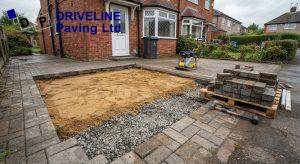
The reassuring part of block paving is that it comes apart. Unlike tarmac or concrete, the surface is a set of individual units that can be lifted, set aside and put back down.
A localised relay suits a contained problem. The affected blocks are lifted and stacked, the laying course and sub-base are rebuilt to the correct depth and compaction, and the original blocks go back.
On a small dip this is often a one day job. Colour matching is the only real complication, since blocks weather over time and a fresh replacement rarely matches an aged surface. Keeping any spare blocks from the original installation is worth doing for exactly this reason.
A full relay makes sense where the sub-base is inadequate across the whole drive, where the falls are wrong, or where several separate areas have dropped. It is also the sensible moment to reconsider the specification.
Rebuilding to a permeable construction deals with the drainage problem that caused the settlement in the first place, and it keeps the work inside permitted development.
Where blocks are heavily damaged or the surface has reached the end of its life, homeowners often look at block paving driveways in a current range instead of reusing what is there. You can see the range of finishes in our gallery of completed projects.
Why Waiting Until Spring Costs More
A small dip is not urgent in August. It becomes considerably more urgent once the weather turns, for reasons that compound.
Standing water in a dip keeps the material below it saturated, which accelerates the washing out of fines. Freezing conditions then expand that trapped water and push blocks further out of line. Loose blocks with open joints let more water straight down into the bedding layer, which produces more movement, which opens more joints. A repair that takes one day in September can become a full relay by March.
There is a safety element too. A rocking paver beside a front door is a genuine trip hazard, and it tends to be worse in the dark winter months when nobody can see it.
Dealing With a Dip Before It Spreads
Sunken block paving is almost always fixable, and it is nearly always cheaper to fix while it is still one small area. The important step is diagnosing what moved rather than simply lifting the blocks and putting more sand underneath, which treats the symptom and guarantees a repeat visit.
Driveline Paving lifts, rebuilds and relays block paved drives across Essex and North London, and our driveway team covering Wanstead and the surrounding areas will look at what caused the movement before quoting for the repair.
If part of your drive has dropped, get in touch for a free assessment or call 01992 879701. Keep it local, Keep it Driveline.